

Microcredit supported Jatropha production in India – a “proof of concept”
Aim of the project was to evaluate viability of small scale jatropha farms on wasteland owned by small farmers. Small scale farmers owning unused wasteland in drought prone areas were provided financial and technical support to plant Jatropha for the production of Jatropha bio-oil.
The project was financed by leading private corporates as part of their sustainability programmes.
Jatropha curcas (physic nut, purging nut) is a shrub or a small tree belonging to the family Euphorbiaceae. It is widely distributed in almost all countries in the tropical regions of Africa, Asia and Latin America. Its seeds have an extractable oil content of around 35%. The plant is usually toxic; however, non-toxic, edible Jatropha varieties occur naturally.

One of the farms on eroded and very rocky area in the beginning and after 1 year
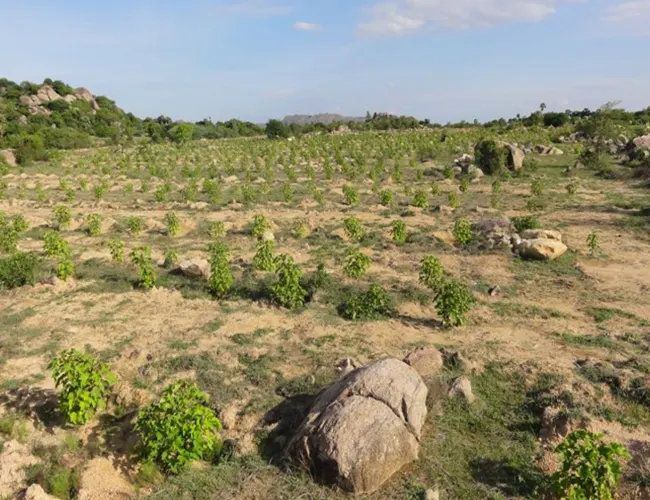
One of the farms on eroded and very rocky area in the beginning and after 1 year
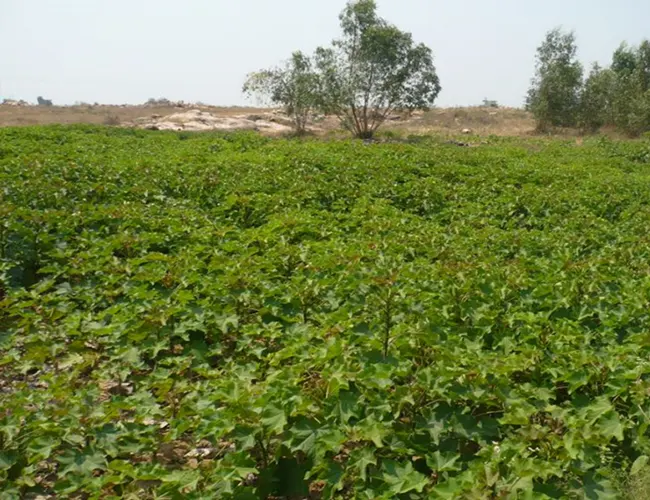
Plants after 3 years at the same rocky area
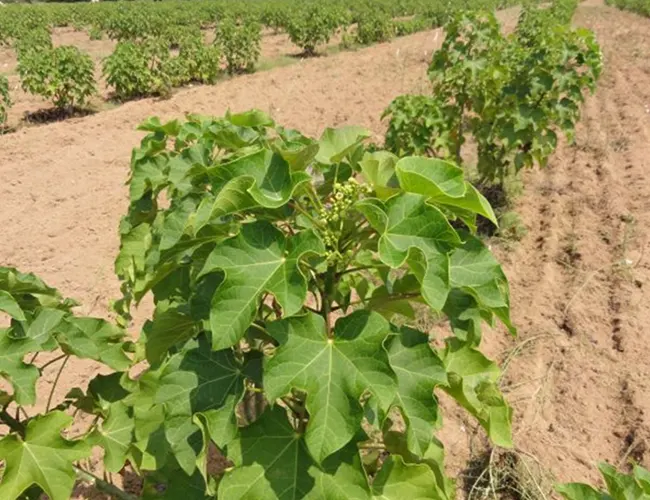
Plants at arid but deeper soil started flowers after 2 years
Jatropha oil, due to its excellent physical and chemical properties, has high potential for fuel oil production. It can be used as straight vegetable oil fuel in adapted motors, as feedstock for biodiesel (European and ASTM standards) aviation fuel and Hydo-Treated Vegetable Oils (HVOs). The project proved that it can grow on comparatively poor soil in semi-arid climates and can therefore be produced without competing with land usually used for food production. In the long run, such eroded areas can be reclaimed as organically rich lands. The project has also provided several insights into the potential of Jatropha as a biofuel crop and resulted in key “lessons learned” on the various aspects to be considered for its successful cultivation.
Cassava (Manihot esculenta) on eroded soil

Bio-ethanol is an alternative or supplement to gasoline (petrol) and has become established as an alternative motor fuel due to cost advantages or policy mandates. As a fuel, bioethanol can be used in the pure form or via blending to conventional gasoline. Future ethanol projects need to address regional conditions (climate, soil quality, employment and infrastructure) in order to be viable and sustainable. LEAS was involved in a study aimed at testing the viability of cassava tuber production as biofuel feedstock on eroded land in Madagascar along with our partners in Germany and Madagascar.
We were involved in the project conception, germplasm collection and planning of the same. The project was carried out by our partner organisation Green.Co sarl Madagascar at Becabija in Madagascar. The 200ha plantation on eroded land could prove that cassava can be produced profitably on wastelands with acidic soils of very low fertility. The profitability calculation took into account the cost of production per tonne required to enable competitive ethanol production. Concepts for both centrally managed plantations and an out-grower model were elaborated. Detailed agronomic information on the tuber productivity and optimised plantation management techniques were generated for a very low level of mechanisation.

Opuntia ficus indica and Euphorbia tirucalli as biogas feed stock

Biogas production technology is well advanced these days. If enough suitable feedstock provided, it could be a solution for energy shortage in remote areas in many developing countries. A continuous feedstock production can facilitate steady power supply to promote development of such regions. Nevertheless the feedstock production should not compete with food production. Plants with CAM (Crassulacean Acid Metabolism) are efficient in biomass production in arid regions. Live Energies Private ltd. was part of a project to evaluate the intensive cultivation of such plants under various planting densities on marginal land in Kenya. Opuntia ficus-indica (L) Mill. (Cactaceae) and Euphorbia tirucalli L. (Euphorbiaceae) are two such CAM plants and were selected for the trial plantation on degraded bush-land near Rumuruti in Laikipia district.
The project provided very promising results regarding the feedstock production possibility on such bush lands without any extra fertilisers after plantation establishment. The specific methane production potential of their biomass was tested with Hohenheim Biogas Test (HBT) at the University of Hohenheim in Germany and found to be viable technologically and economically. These trials helped to evolve best practices for industrial Opuntia and Euphorbia cultivation, harvesting and processing and design a suitable biogas plant as well as to define the pathways of biogas use in tropical countries. The project was coordinated by our sister company, Live Energies GmbH, Germany and implemented by Live Energies ltd. Kenya.
